

Reflecting on a Galaxy Far Away with Alan Dean Foster After Ten Years
For the 10th anniversary of Star Wars: The Force Awakens, we revisit an interview with Alan Dean Foster, the author who wrote the official novelization for the blockbuster film back in 2015. The prolific American author of science fiction and fantasy is widely known to Star Wars fans as the ghostwriter for the original 1976 novelization, Star Wars: From the Adventures of Luke Skywalker, and the first intended sequel, Splinter of the Mind’s Eye, written with the intention of being adapted as a low-budget sequel to the first film in case it was not successful.
Foster’s novelization of The Force Awakens is a book that gives readers the opportunity to dive deeper into expanded dialogue of the characters, providing more clarity into their inner lives and explores additional scenes that share more insight into its story. So now, in recognition of the film’s monumental anniversary, here is one of the most memorable interviews with the legendary writer.

When you wrote the Star Wars novel, did it give you the feeling of the revolution that the (original 1977 Star Wars) movie was supposed to be?
“No. Everyone who saw it in the early days knew it was a great film, but no one predicted the overwhelming, and continuing, success it would have.”
What were your sources when you wrote The Force Awakens novelization? Did you have access to a script that was very close to the final one?
“I was provided with a copy of the screenplay that was very close to what appears on screen. Remember that scenes and dialogue in a film are often changed right on the set, in the course of filming. I was also given access to some still shots of characters, backgrounds, etc. I saw no film footage.
Did you speak with Director J.J Abrams during the writing of the book?
“No, I’ve never met J.J. and vice versa. Doing a small film is a 24/7 project, and a film like this more like a 25/7 job. I’ve been on sets with directors making nine figure-plus films and you’re lucky if you can get a midnight meeting with them while they’re eating dinner…. I’m sure we’ll bump into each other one of these days, and talk about anything other than Star Trek and Star Wars.”
In your novelization of The Force Awakens there are some elements that in the film are not appreciated, but that seems to be able to suppose a clue for the future of the saga. We do not ask you to tell us but, did (Lucasfilm) give you any indications about what was coming in (following films) The Last Jedi and Episode IX (The Rise of Skywalker)?
“No. Not a clue. Safer that way. I don’t like knowing too much; it takes me out of it.”

What did you the enjoy most? Writing a young Han Solo in Star Wars, or an old Solo in The Force Awakens?
“I enjoyed both. Writing the old Han Solo allowed me to show that even heroes can grow tired being heroes.”

Han (Harrison Ford and Leia (Carrie Fisher). Image courtesy of Lucasfilm.
A compelling question, what do you think of Star Wars The Force Awakens?
“I thought it captured the spirit of the original SW beautifully. Making something like TFA is like seeing an old girlfriend from your youth after forty years have passed. You know she won’t look the same, but you want the meeting to feel the same.”
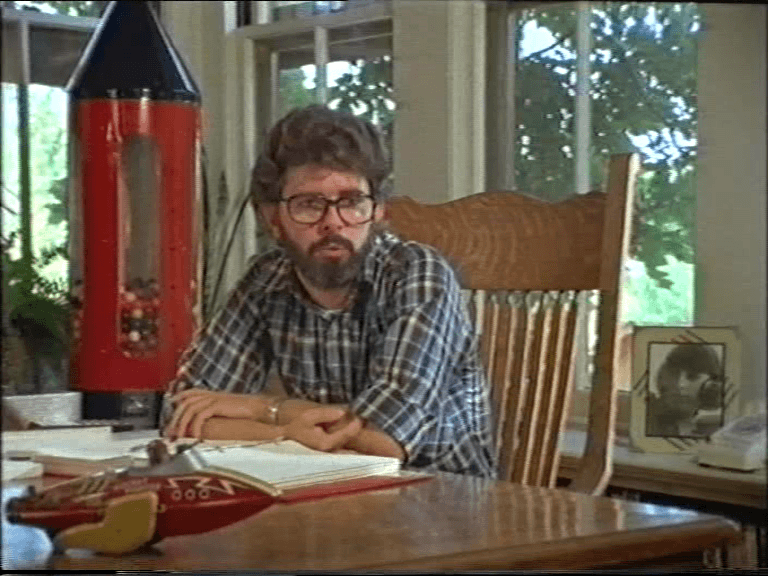
Star Wars’ Director George Lucas. Image courtesy of Lucasfilm.
Foster added a verse from the fictional “Journal of the Whills” to the beginning of his novelization of Star Wars: The Force Awakens. A verse that was a callback to George Lucas, who put it into his early Star Wars drafts. It was a way for Foster to reintroduce an old idea that was originally used. The passage from the Journal of the Whills in The Force Awakens novelization differs and says: “First comes the day. Then comes the night. After the darkness shines through the light. The difference, they say, is only made right by the resolving of gray through refined Jedi sight.”
The author included George’s original Whills idea in an excerpt in his novelization of the original Star Wars film. So why not make that connection with a story that begins the conclusion of the Skywalker saga? While the concept was dropped from future films, it has been slightly reintroduced into the current canon through various other sources like Rogue One: A Star Wars Story, which introduced a similar concept of the “Guardians of the Whills.”

George Lucas’s original script for Star Wars was titled “The Adventures of Luke Starkiller as taken from the Journal of the Whills.” He originally intended for the story to be told by mysterious or God like beings called “The Whills.”
About the Journal of the Whills… you used this concept forty years ago, and again in 2015 with The Force Awakens novelization. Did George Lucas tell you something about what or who they were back in time?
“Nothing. I assumed that the Journal had been compiled by some species, human or alien, that stood outside and above the actions that take place in the SW universe. Not quite the gods looking down from Olympus, but a similar idea.”

Scene from Star Wars The Force Awakens. Image courtesy of Lucasfilm.
The award winning writer went on to say that there was “obviously the beginnings of a relationship” between Finn (John Boyega) and Rey (Daisy Ridley) that didn’t materialize and was removed from his novel. The author said that when he attempted to water seeds that were planted for an eventual future Finn-Rey romance, he was forced to remove the lines of dialogue. He told Midnight’s Edge.
“I did my usual thing when I do these adaptations of trying to fix things that I think need fixing in the story and fixing in the science. Not so much with the characters, because the characters are fairly well-established in a screenplay,” he continued. “Some things they said to take out, and some things they left alone. Some of the things they said to take out I thought were silly and would really have improved the book if I had been able to leave them in the book, but I can’t talk about those.”

©Walt Disney Co./Courtesy Everett Collection
Disney executives forced Foster to remove the romantic undertones between Finn and Rey that he originally included in the script. He felt this was a “beginning of a relationship” that was then not developed further in the subsequent movies, like The Last Jedi.
“There were a couple of things in there, and a couple of things that happened subsequently that bothered me. I’m going to tell you one thing they made me take out because enough time has passed, I don’t think it matters,” Foster said, adding only that there was “obviously the beginnings of a relationship” between Finn and Rey.

Daisy Ridley in “Star Wars: The Force Awakens.” Walt Disney Studios
There were many things that were added to his original draft of the novelization but were removed for the final version. One example was having Han Solo say “Don’t get cocky, kid” to Rey after she fixes the Millennium Falcon, a clear callback to the original film. Another example was his attempt to “fix the science” of the Starkiller Base superweapon by adding a more detailed, scientifically plausible explanation for its power source which wasn’t clearly alluded to in the film.
Foster has mentioned that control over novelizations for major franchises is very tight to ensure everything remains canon. While he was allowed to add character inner thoughts and motivations to The Force Awakens, major plot elements were strictly controlled by the studio.
There are, of course, interesting things that made it into the novelization that are not present in the final theatrical cut, such as more details about Poe Dameron’s escape from Jakku, an expanded confrontation between Rey and the junk dealer Unkar Plutt, an introduction for Leia that comes before Han sees her for the first time in years, and also a “moment” between Rey and Poe back at the Rebel Base, where they embrace upon realizing they’ve found a path to victory.

Image courtesy of Lucasfilm.
Did you get to see the film in advance in order to help you with your writing?
“No, I just saw it on Saturday morning, the day after it opened. Unlike the two Star Trek films, I didn’t get to see the film while I was writing, which was a shame — it would have made the novelization even better. It always does! I did get to see a fair number of still photos of the settings and the characters in costume. I really made a case for that. I told the studio, “The screenplay describes Rey’s scavenger outfit as being a certain way, but it would be useful if I could see the thing instead of having to invent it — pun not intended — out of whole cloth.” He continued, “They relented, so I got to see pictures of devices and sets. For example, the descriptions of Maz Kanata’s cantina in the book reflect the images I saw, some of which were completed and some that weren’t.”
As with all things that differ between the novel and theatrical release, you’ll have to decide between which is better for you. I myself find the novelization more suited for my taste.
May the Force be with you…. And Happy The Force Awakens 10th Anniversary. Give the film a watch again and then check out the novel by Alan Dean Foster available at Amazon.com and book dealers online.
Portions of the article was taken from the complete interview at Lafosadelrancor.com
 Next Level Media Plus | Outerworld and StarWarsGalaxyNews
Leave a comment